

Key Takeaways:
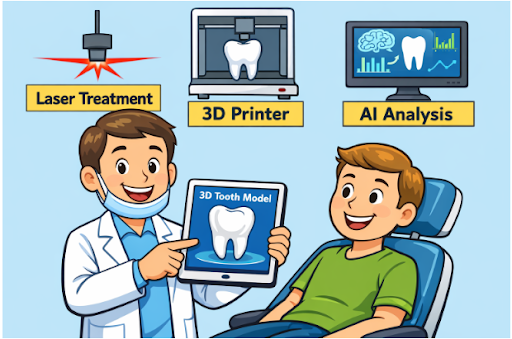
- Advancements in dental technology are enhancing diagnostic accuracy and treatment efficiency.
- Digital tools like 3D imaging and AI are improving patient experiences and outcomes.
- Innovations such as 3D printing and laser dentistry are revolutionizing dental procedures.
Table of Contents:
- Introduction
- Digital Imaging and 3D Technology
- Artificial Intelligence in Dentistry
- 3D Printing in Dental Care
- Laser Dentistry
- Teledentistry
- Patient Experience and Engagement
- Conclusion
The dental industry is rapidly evolving as technology continues to reshape how care is delivered and experienced. With the integration of cutting-edge digital tools, patients can now expect more precise diagnostics, faster treatments, and an overall improved journey from consultation to recovery. In particular, digital advancements in dental implants demonstrate how both common and complex dental procedures are being improved for patients and practitioners alike.
As new innovations like artificial intelligence and 3D imaging become standard in modern dental practices, the gap between traditional methods and the latest technology grows more apparent. These developments bring faster solutions, minimize discomfort, and offer highly personalized care. Dentists equipped with advanced tools can detect issues earlier and plan procedures with unmatched accuracy, resulting in healthier outcomes for their patients. The future of dentistry undoubtedly lies at the intersection of human expertise and digital transformation.
The impact of these transformations extends beyond technology itself, shaping patient expectations and industry standards. These advancements are making dental care more comfortable, accessible, and effective than ever before.
Digital Imaging and 3D Technology
Modern dental offices are moving away from traditional film X-rays in favor of digital radiographs and three-dimensional imaging like cone beam computed tomography (CBCT). These technologies give practitioners far deeper insights into oral structures, allowing for more thorough evaluations and individualized care plans. CBCT, for example, creates precise 3D models of teeth, bones, and soft tissue, supporting procedures such as dental implants, root canals, and oral surgery. This accuracy enables dentists to anticipate complications, tailor interventions, and track progress over time with minimal exposure to radiation.
Digital imaging not only benefits diagnosis but also improves patient communication. Dentists can easily share images and 3D scans with patients, empowering them to understand their treatment options and make informed decisions about their care. The shift to digital tools likewise minimizes wait times, since results are available within moments and can be shared instantly between specialists if needed.
Artificial Intelligence in Dentistry
Artificial intelligence (AI) is transforming how dentists approach diagnosis and treatment planning. By using machine learning algorithms, dental professionals can analyze X-rays and historical patient data to detect diseases at earlier stages, predict outcomes, and generate tailored treatment plans. Studies indicate that AI-assisted practices can see up to a 37 percent increase in disease detection and a substantial decrease in insurance claim denials. This leads to fewer missed problems and faster, more accurate treatments.
Moreover, AI simplifies complex diagnostic patterns that often require expert review, helping general practitioners deliver specialist-level care in standard appointments. As AI tools become more integrated into daily practice, patients can trust that their care is based on the latest evidence and informed by comprehensive, real-time data analysis. The promise of AI in dentistry continues to grow as these systems become smarter, more accessible, and more widely adopted.
3D Printing in Dental Care
One of the most significant advances in dental technology is the use of 3D printing for creating custom dental solutions. Crowns, dentures, aligners, surgical guides, and even entire jaw models can now be fabricated in-house with exceptional speed and accuracy. This means patients can receive bespoke appliances in as little as one appointment, enjoying better fit and comfort as a result. The flexibility of 3D printing allows for rapid adjustments and minimizes the need for repeated impression-taking, reducing both cost and inconvenience for patients.
Laser Dentistry
Laser technology has opened the door to minimally invasive procedures that dramatically reduce discomfort and promote faster healing. Whether being used for cavity detection, soft tissue surgery, gum reshaping, or cosmetic enhancements, lasers offer precision that conventional dental instruments cannot match. Patients experience less pain and swelling, and the risk of infection is also lowered due to the sterilizing qualities of laser light. Laser whitening and periodontal treatments are increasingly popular, as they provide convenient and highly effective results.
Teledentistry
The growing adoption of teledentistry is breaking down barriers to care, making it possible for patients to access dental expertise from virtually anywhere. Remote consultations allow dentists to screen symptoms, guide oral hygiene practices, monitor ongoing treatments, and even prescribe medications without an in-office visit. This is especially valuable for individuals in rural or underserved areas and for patients with mobility issues. The American Dental Association found that teledentistry significantly expands access to preventive and specialty services, benefiting both patients and providers while optimizing appointment schedules and minimizing unnecessary office visits.
Patient Experience and Engagement
Improved technology does not just benefit dentists; it also greatly enhances the patient experience. Digital scans, AI-powered platforms, and interactive treatment models enable patients to visualize outcomes and understand the purpose of each step in their care. This transparency fosters trust, helps alleviate anxiety, and motivates patients to actively participate in maintaining their oral health. Tools like patient portals, mobile apps, and automated reminders support communication, boost engagement, and improve adherence to treatment and preventive measures.
Conclusion
The transformation driven by dental technology is resulting in improved diagnostics, efficient treatments, and a more empowering patient experience. From digital imaging to AI and 3D printing, these advancements promise a future where dental care is more accurate, less invasive, and significantly more accessible. As the dental profession embraces these innovative solutions, both patients and practitioners benefit from a new era of high-quality, patient-centered care.